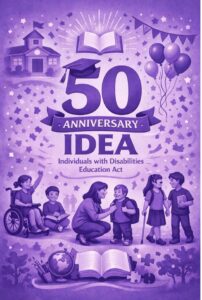
AI-generated image created using ChatGPT (OpenAI), based on author-provided prompts, 2026.
Fifty Years of IDEA: Looking Back to See the Road Ahead
Fifty Years of IDEA: A Moment Worth Pausing For
For fifty years, the United States has benefited from the protections and promise of the Individuals with Disabilities Education Act (IDEA). Anniversaries invite reflection, and this one calls us to do more than celebrate. It asks us to look carefully at where we have been, what we have learned, and what kind of future we are still responsible for building.
Remembering Public Law 94-142
I was first exposed to the Education for All Handicapped Children Act of 1975 (EAHCA) while in graduate school at Chadron State College (NE) in the early 1980s. I was working on my master’s degree in career vocational guidance and taking my first formal course in vocational evaluation. My professors consistently referred to the legislation as Public Law 94-142, and even today that is still how I remember it.
As part of that course, we were introduced to the concept of non-discriminatory evaluation. The message was clear: we could no longer rely on a single test or score to make decisions about a student’s future. Evaluation had to be fair, comprehensive, and contextual. We were also introduced to the idea of the Individualized Education Program (IEP)—a structured, collaborative process designed to individualize opportunity. From a vocational evaluation perspective, this reinforced the importance of inclusive planning and the belief that opportunity grows when barriers are intentionally removed. Public Law 94-142 became the foundation for what we now know as IDEA.
Rights, Not Favors: The Core Protections of IDEA
The Education for All Handicapped Children Act introduced several transformational changes to American education. First, and most significantly, it established the right to a Free Appropriate Public Education (FAPE). For the first time in our nation’s history, children with disabilities were guaranteed access to public education at no cost to their families, regardless of the severity of disability. Education became a civil right—not a privilege to be granted or withheld.
The law also introduced the principle of Least Restrictive Environment (LRE), requiring that students with disabilities be educated with their non-disabled peers to the maximum extent appropriate. While imperfect in practice, this provision began dismantling systems of segregation and institutional isolation. IEPs were required to include written educational goals, a description of services, methods for measuring progress, placement decisions, and meaningful family involvement.
Equally important, EAHCA introduced due process protections. Parents gained enforceable rights, including notice of changes, consent or refusal of services, access to impartial hearings, and the right to appeal decisions. Children could no longer be excluded from public education because of disability, and families were no longer passive recipients of decisions—they became equal members of the IEP team.
Individualized Planning as an Opportunity
IDEA has evolved steadily since its passage. In 1986, services for infants and toddlers were added (now Part C). In 1990, the law was formally renamed the Individuals with Disabilities Education Act, and transition services were introduced. Education was no longer viewed as an end in itself, but as preparation for adult life—work, independence, and community participation. Transition planning became a required component of the IEP, beginning no later than age 16.
These changes strengthened partnerships between education and vocational rehabilitation and formalized collaboration with qualified rehabilitation counselors. IDEA was no longer just about access to school; it was about building a future.
Education With a Future in Mind: Transition and Adult Outcomes
The 1997 amendments further strengthened the law by shifting the focus from access alone to achievement and results. Students with disabilities were expected to participate in the general education curriculum, and their outcomes became part of state and district accountability systems. IEP goals were required to align with academic standards, reinforcing the expectation that students with disabilities are learners with potential—not exceptions to accountability.
Raising the Bar: Accountability and Achievement
I was fortunate to be personally involved during the 2004 amendments to IDEA. As a state vocational rehabilitation agency director, my team and I worked with Senator Patty Murray’s staff in Washington, D.C., reviewing drafts and offering practical insights from the field. It was a rare and meaningful opportunity to see how policy and practice can inform one another.
The 2004 amendments emphasized evidence-based instruction, refined learning disability identification, reinforced requirements for highly qualified teachers, streamlined elements of the IEP process, and increased attention to measurable post-secondary outcomes. IDEA was aligned with the accountability framework of No Child Left Behind, reinforcing the law as a minimum national standard for services to students with disabilities.
Where Education Meets Employment: IDEA, VR, and WIOA
In 2014, the passage of the Workforce Innovation and Opportunity Act (WIOA) further strengthened IDEA through alignment with pre-employment transition services. Vocational rehabilitation agencies assumed new responsibilities, including required collaboration with school districts and the provision of job exploration counseling, workplace readiness training, self-advocacy instruction, postsecondary counseling, and work-based learning experiences. IDEA and VR became even more closely linked in their shared focus on meaningful adult outcomes.
What the Courts Affirmed: Progress Must Be Meaningful
System alignment continued to evolve. In 2017, the Supreme Court’s decision in Endrew F. v. Douglas County School District clarified that FAPE requires more than minimal progress. Educational programs must be “reasonably calculated to enable a child to make progress appropriate in light of the child’s circumstances.” The Court affirmed that IDEA is not about guaranteeing identical outcomes—it is about ensuring meaningful opportunity for progress.
Personal Experience
IDEA is not abstract to me. I have two grandchildren with disabilities who have navigated the IEP process in their local schools. The journey has not been easy, but it has mattered. Understanding the expectations of the law empowered our family to advocate effectively. Without IDEA, their opportunities would have been dramatically limited.
Stewardship of a Civil Rights Legacy
For more than fifty years, IDEA has reshaped the future for millions of students with disabilities. Without it, countless children would have been excluded, isolated, or forgotten. Instead, IDEA opened doors to postsecondary education, competitive integrated employment, and independent living. As alignment with workforce systems continues to strengthen, the potential for meaningful adult outcomes grows even greater.
Concerns remain. Proposed changes at the federal level, including restructuring within the Department of Education and reductions in staffing within the Office of Special Education and Rehabilitative Services (OSERS), have created uncertainty and anxiety. Questions about funding distribution, oversight, and enforcement are legitimate. Still, it is important to remember that IDEA remains the law of the land unless and until Congress acts.
Even in uncertain times, IDEA endures. Its partnerships with vocational rehabilitation and workforce systems amplify its power and relevance. At its core, IDEA remains focused on opportunity—on the belief that disability should never determine destiny. Fifty years in, IDEA stands as the most consequential education legislation ever written for students with disabilities and their families. It has changed lives. This anniversary is not only a moment to celebrate, but a reminder of our responsibility to protect, strengthen, and carry forward its promise.
Edited with the assistance of ChatGPT