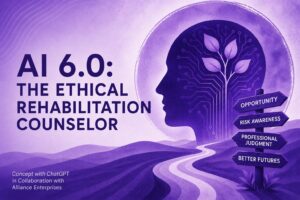
AI 6.0: The Ethical Rehabilitation Counselor: Balancing Opportunity and Risk in the Age of AI
Over the last almost 50 years, there have been many tools that proposed to make my work easier. When I began, we did not have computers or electronics. Over time we went from handwritten notes, to Dictaphones, then to computers and electronic case management systems, to email, smartphones, to telehealth and now to artificial intelligence (AI). All came with promises to make work more efficient and make me more productive. None of these tools changed my ethical responsibilities as a vocational rehabilitation counselor. AI does not either.
Technology Changes. Professional Responsibility Does Not
I also want to be clear that I believe AI is a powerful and important tool for rehabilitation counselors. Building a profile and creating effective prompts are important first steps, and we have already discussed those topics. The next step is learning how to use AI responsibly. Like every tool that has come before it, AI is most effective when it is guided by ethical decision-making, professional judgment, and a commitment to expanding opportunities for the people we serve.
So, our next question is: how do we use AI in ways that strengthen our professional practice while protecting the people we serve?
In most cases, the greatest risk is not the technology itself—it is how we choose to use it. This means human decision making on the part of the counselor is where we must ethically focus.
Four Questions Every Rehabilitation Counselor Should Ask
In 2024, The National Institute of Standards and Technology (NIST) provided specific guidance regarding AI and effective risk management. Information from this report can be summarized to help rehabilitation counselors make decisions about ethical use of AI in their practice. Although NIST specified 12 common risks, I think they can be reduced to four important questions practicing rehabilitation counselors must ask as they use AI.
Question 1: Am I protecting the information of the person that I am serving?
AI systems risk breaking confidentiality by releasing personal identifiable information (PII). Any PII entered into public AI systems becomes part of the training model and the public record. Additionally, because AI systems rely on information entered, there is risk that bad players may enter deep fakes or false information that become part of the model. Counselors must be vigilant to evaluate the integrity of the information it considers.
There are information security risks for counselors to consider. Like any technology, AI introduces new cybersecurity risks. Counselors should recognize that AI systems can be manipulated or compromised, making it essential to protect sensitive information and verify the accuracy of AI-generated responses.
Question 2: Can I trust this answer?
Confabulation, most often referred to as hallucination, must be considered. AI will create and confidently present false content in response to prompts. One of AI’s greatest strengths is that it produces responses that read naturally and confidently. Ironically, that can also be one of its greatest weaknesses. Sometimes those responses are not true, even though they sound completely believable. That’s why rehabilitation counselors should never assume that a polished answer is necessarily a correct one. This is an ethical issue for our practice. Your decisions matter.
Examples where this could be particularly important might include having AI summarize medical record and education history. AI has the potential to create a summary that might look correct but is incomplete or inaccurate. The counselor must review and assure accuracy.
The greatest danger is not that AI will make a mistake. The greatest danger is that we, as vocational rehabilitation counselors, may stop questioning its answers.
If we just accept what AI gives us, at some point we will be wrong and harm the people we serve.
Question 3: Whose perspective is missing?
Personally, I think the biggest risk we face using AI is harmful bias and homogenization. In any automated system, bias becomes ingrained. AI can increase the speed and scale that bias occurs. When considering employment, it may automatically underrepresent people with disabilities, women, and racial minorities. This bias stems from the original training data where stereotyped information is consistent with stereotypes that already exist in society.
The information provided can increase disparities in discriminatory decision-making. If we don’t question the information, we may minimize opportunity for the people we serve. AI does not automatically consider possibilities that include accommodation, assistive technology or professional experience from qualified vocational rehabilitation counselors.
Because AI systems rely on internal training models for the system, information becomes homogenized, or as I often say, it is genericized. Generic information does not produce the best results for people with disabilities. Experience and belief in greater possibility is what makes a difference for people with disabilities. AI is trained to recognize patterns in existing information. Rehabilitation counselors are trained to recognize possibilities that existing patterns often overlook. Professional judgment, quality prompts, decision-making that challenges the homogenized information and asking the system to “think deeper” is what produces better opportunity for people with disabilities. Without our professional opinions, over-reliance on the system produces a restriction on what is possible.
Think about it this way; AI automatically brings everything to the average. The people we serve are unique individuals. If we want to create the best opportunity for the best career, we must look at all possibilities. As an example, you ask AI to help with career planning. Unless you include expectations for all possibilities and incorporate the person’s interests, their values, the impact of assistive technology and accommodation, and the capacity of the person to build skills, you will see the system exclude them from the best jobs.
Question 4: Am I still exercising professional judgment?
This question is about how counselors interact with AI. Probably the biggest risk faced in this situation is that counselors can over-rely on the information produced by AI. We can perceive the system as having greater expertise than we have from our counseling experience and defer to what AI is telling us, rather than trusting our clinical experience. This reliance on AI can increase risks of confabulation, bias, and homogenization, because we trust the system more than we trust ourselves.
In the end, our experience must guide our decision making – not AI.
Conclusion
Every generation of rehabilitation counselors has learned to use new tools responsibly. It will never replace professional judgment, ethical decision-making, or our belief in the potential of the people we serve. Those remain, and always will remain, the responsibility of the rehabilitation counselor.
AI is the next step in advancing our practice as rehabilitation counselors. It does not come risk free. It requires risk management on our part. We remain responsible in our shared partnership with the people with disabilities that we serve. AI will enhance success, but only when our professional decision making drives the process. I believe it will create greater opportunities for better futures when rehabilitation counselors apply the principles we have discussed. It is a bright future.
*This article has been edited with the assistance of ChatGPT.
*This article was informed by the National Institute of Standards and Technology’s (NIST) Artificial Intelligence Risk Management Framework: Generative Artificial Intelligence Profile (NIST AI 600-1), adapted for vocational rehabilitation counseling practice.
National Institute of Standards and Technology. (2024). Artificial intelligence risk management framework: Generative artificial intelligence profile (NIST AI 600-1). U.S. Department of Commerce. https://doi.org/10.6028/NIST.AI.600-1