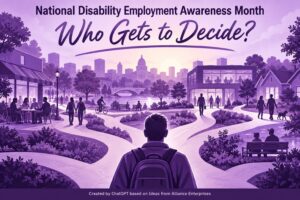
National Disability Employment Awareness Month: Who Gets to Decide?
National Disability Employment Awareness Month is coming up in October. As I began to think about what this might mean, I looked back on my own experiences partnering with people who have disabilities who want to work.
Many years ago, a colleague and friend asked me some difficult questions. He asked me who decided I was job ready? Who decided when I could live on my own? Who decided what I did on Friday, what groceries I bought, how late I stayed up? Who decided who I would hang out with and what my hobbies were? Who decided who I could date or marry? Who decided where I lived? Who decided when I could take risks or make mistakes? Who decided what my career would be?
My friend has since passed away, but I can still hear his words.
The Opportunity to Try
These ideas came from the Fountain House movement. We both had clubhouse experiences. I once asked Ralph Bilby, the leader of transitional employment (TE) at Fountain House for decades and considered the foremost expert on the subject, “How do you know when someone is employment ready?” His answer was simple, “When the member asks for a job!”
Ralph’s thoughts around this were simple. Success comes when a person attempts a job, even if they only last one shift. They can try again and maybe they will last longer. Over time, they can build the attitude and stamina to last on a job of their choice. Experience builds for future opportunities.
I think back to my own work history. I had a lot of jobs before I ended up in my career: hay hauling, house painter, roofer, construction laborer, painting trucks and tanks, plumber’s helper, working on a chicken farm, working in a meat packing plant. None of these would lead to my career. Some lasted a couple years and some a few days. I was fired from a couple and eventually quit all of them. All led to where I am now. Most of these I did not like! They were all my choice.
Many vocational rehabilitation (VR) counselors are worried that perceived failure on a job for the participant will interfere with future work. Ralph asked me if I had ever failed on a job? The answer was of course yes! Next, he asked if that meant I did not get another job or hurt my future employment. The answer of course was no! Protecting people from potential perceived failure he believed was a form of disrespect for the capacity of the person to learn from their experience.
Failure is a great teacher. It provides experience.
One of my early TE placements was at Cirrus House in Nebraska in the 1980s. I had a gentleman who really wanted to be a cook. I found a position at a nursing home in the kitchen as a dishwasher. He tried it. He lasted one shift with a lot of support. I had to put someone else in the position the next day. However, I continued to work with him. Dishwashing in the kitchen was not the same as being a cook. Several placements later he became a part-time short-order cook. He held the position until his health interfered.
Before this experience, I might have just decided this person was simply not able to work. Certainly, my professional training would have supported this. The psychiatrist at the facility really did not want to have this person work. He was worried it would make his schizophrenia worse. In the end, being employed was part of what helped him stabilize and stay out of the hospital.
Who Gets to Decide?
I began to ask these questions of vocational rehabilitation counselors who worked with me or for me. Who decides the work and life choices of the individual we serve?
A bigger question is when we as rehabilitation counselors think about inclusion and integration, what do we really mean? We have been trained to help people work and live independently, but how does our work lead to full citizenship in the community?
Realistic and Appropriate
Another question is what does opportunity look like? I hate the terms realistic and appropriate when we think about opportunities for the people we serve. When we, as counselors, make decisions about whether work, or housing, or financial choices are realistic or appropriate, what are we saying about the decisions of the person we serve? “Realistic” and “appropriate” become ways to say no! Our judgment matters, but does this reflect choice?
We are vocational rehabilitation counselors. Our role is important for success, but it is only one component in the partnership leading to employment. Our skills connect with employers, training programs, supports, and understanding of the world of work. Counseling skills matter. Relationships with employers matter. Our education and credentials provide clinical judgment. Our skills contribute to the partnership.
Who gets to define what is realistic and appropriate for another person’s life?
Who Owns the Life?
The person in front of us has expertise we don’t. They are experts about their day-to-day experiences, their choices, their resources, what gives them joy, what makes them angry, who they want to be with, accommodations that have worked or failed, and technology that has worked or failed. They are experts about their own life and their lived experience in their community. This makes them the key partner in the process, and it means they should own the process.
Self-determination and belonging do not mean a person cannot have supports at work, in housing, in managing money. It does not mean a person must live without assistance. Self-determination ultimately means choice in all aspects of life, even if external supports are needed.
Choice, regardless of success or failure, rests with the person who must live with the results.
Alie B. Gorrie, host of Nothing Without Us, recently stated, “We put people with disabilities in a bubble and that bubble needs to be popped” (Gorrie, 2026, 11:37). People with disabilities require the opportunity to succeed or fail. That is part of the full human experience.
More Than Employment
As I reflect on National Disability Employment Awareness Month, I think about the role vocational rehabilitation counselors have and about the role employers have in creating opportunities. When I consider the people we serve, I understand that employment is only part of the equation for a full life.
A full life includes not only the opportunity to succeed, but the opportunity to fail, recover, learn, change direction, and try again. Work matters. Support matters. Inclusion matters. Belonging matters. But the person owns the life.
Friends, relationships, recreation, community, faith, hobbies, going out or staying home on Friday night, who someone spends time with, what brings a person joy, and work, are all choices to be made. Ultimately, only the participant must go home to live their life and make these choices.
So, we return to the question: Who decided you were employment ready? Who decided where you live and how you spend your money? Who decided who you spend time with, who your friends are, who you date or who you love? As rehabilitation counselors, it is important to ask these questions if full citizenship and inclusion and belonging are to be part of the lives of the people we serve.
As we celebrate National Disability Employment Awareness Month, perhaps the bigger question is not only who gets the opportunity to work, but who gets the opportunity to choose the life they want to live.
References:
Gorrie, A. B. (Host). (2026, September 2). Nothing Without Us! Episode 21 – Hank Poore and Ashley Ferry [Audio podcast episode]. In Nothing Without Us! A Disability Advocacy Podcast. Lakeshore Foundation. https://www.lakeshore.org/about/nothing-without-us/
*Edited with assistance of ChatGPT