AI 8.0: When Tools Change, Does the Craft Change?
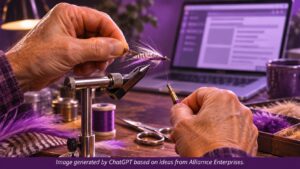
As I began to think about this blog, I thought about my fly-tying desk. I have many tools organized on the desk, each serving a specific purpose. They allow me to be more precise, creative, or efficient. From time to time, I discover a new tool that I am certain I need. I research each new tool and eventually select the new item from a trusted company and begin to use it. Often, the new tool replaces other tools that worked well for me.
Over time, the old tools sit on my work bench unused. The new tool does it better. However, sometimes a little something is lost by not using the older tool. I might bypass a few steps to get the task completed more rapidly. Maybe I can create more flies, but has the quality changed, or is it as precise, or is my joy less? The question becomes: what has changed in me?
The new tool helps me with my craft that I learned through experience. I know when the fly is not balanced, if the proportions are not right, and I understand why certain materials work together. This comes from my experience, not the new tool.
I wonder whether the same thing happens in rehabilitation counseling with AI?
When New Tools Become Part of Our Practice
Over the more than a century of vocational rehabilitation practice, we have tried and adopted many new tools. We have gone from paper records and manual occupational records to electronic case management and online labor-market systems. Some have fundamentally changed our practice.
Artificial intelligence (AI) is becoming more popular among vocational rehabilitation professionals; we are seeing AI become integrated within case management software. As I speak with counselors and VR leaders across the country, I am learning about the growing range of tasks AI can support. These include summarizing records, assisting with comprehensive assessments and eligibility determinations, supporting annual reviews, quickly locating evidence, converting draft notes into professional documentation, identifying action items, and automating routine communications with consumers. The list of possibilities is substantial.
In conversations with VR leaders across the country, I am hearing about the use of AI to document counselor performance, complete analytics and assist with financial planning. This information can influence important agency decisions.
AI has great potential to improve our services for people with disabilities. This does not mean we should avoid important questions about the impact of AI.
What happens when AI sits inside our ordinary workflow tools, when it becomes a natural part of our day-to-day work and we don’t think about the tasks it is performing?
Do these automated actions from AI in case management systems improve the experience for the people we serve as vocational rehabilitation counselors?
Efficiency Is Not the Same as Effectiveness
For many of us, efficiency is hard-wired into our practice. Large caseloads, complicated needs and expectations for the people we serve, greater expectations for connection with employers and community organizations, increased reporting requirements, and our regular meetings all require us to be efficient.
New tools cannot replace sound professional practice. Some automated actions free up time for us.
Several questions must be asked. Suppose AI summarizes case notes for multiple consumers. Who determines whether each note accurately represents the individual’s story?
Suppose AI suggests specific language. Who owns the documentation?
Suppose AI makes recommendations for specific items to become included in an individual employment plan. If the counselor recommends what AI suggests, does the consumer still exercise choice about the inclusion of those items?
Do we understand how our AI systems use and protect consumer information, and whether that information influences future recommendations?
Whose Future Are We Planning?
As an example, I have watched technology change the way we explore career choice. In days past, I used The Occupational Outlook Handbook and Dictionary of Occupational Titles as career search tools. As computers and the internet became more widely used, I began using O*NET to complete these tasks more quickly. However, I ensured choice remained with the consumer.
Now AI has the capacity to offer more choices almost instantly, but the decision is still a partnership between counselor and participant. A trusted counseling relationship makes the difference. Perhaps the efficiencies gained from speeding up the search can be used for thinking, wondering, discovery and conversation that leads to ownership of the process by the participant. Our focus remains increasing autonomy and choice for the person with a disability. After all, it is their future that we serve!
What happens with the time we save? Will we use it to serve more people, develop more employer relationships, spend higher quality time with the people we serve? Will it increase choice?
A rehabilitation counselor who uses AI in their case management system is most effective when it helps them think, provides ideas they have not considered, but does not allow the system to do the “thinking” for them.
Imagine preparing to meet with a participant who has received services from your agency for several years. AI can quickly provide a summary of dates, services, employment history, skills and interests. As we review it before meeting with the person, do we trust it exclusively? What if it left out key skills, expressed interests, training, accommodations that have worked in the past, or barriers? It was quick, but was it complete? Or what if it confidently introduces a new observation, one that may not be true, or one that relies on existing bias that limits choice? We risk both omitting important information and introducing false or biased information.
The Craft Still Matters
As systems become more capable, responsible counseling practice still requires us to be the decision maker. We review, edit, evaluate, ask questions, and then we decide.
Our skills as rehabilitation counselors remain essential. We still must build relationships, work with consumers to ensure informed choice, help expand opportunity, and evaluate what is possible and what is needed. We are responsible – not AI.
For community rehabilitation programs and state vocational agencies, these new efficiencies may create opportunities to serve more people more effectively.
Every new tool gives us something. The professional question is: Will we notice what it quietly took away? Rehabilitation counseling matters. It is important to not lose our unique professional skills while gaining what AI can contribute.
We cannot hand over our autonomy as a professional. We must build in a review for each decision point. We can’t just click finish. Meaningful review is more than just accepting a document because it sounds polished.
Back to my fly-tying desk. The new tool may allow me to work faster, make more flies, make the work a little easier. It may even improve the quality of the fly I tie. Some old tools that were once indispensable are no longer used. However, it doesn’t replace the decisions that rest with me. I still must decide threads, materials, colors, hook size, and the kind of fly I will tie. The quality of the fly and the decisions about what is completed rest with me.
New tools can improve our craft, but only when we remain actively engaged in learning, questioning, and making decisions.
*Edited with the assistance of ChatGPT