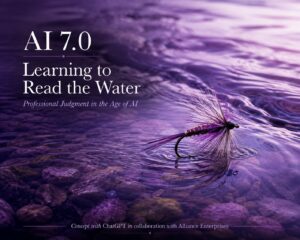
AI 7.0: Learning to Read the Water — Professional Judgment in the Age of AI
As we take the next step in this series about artificial intelligence, there is a critical question. How do we gain the benefits from AI to improve our rehabilitation counseling practice while ensuring our essential role with the consumer is not replaced? What are the parts of our vocational rehabilitation practice that cannot be delegated to AI?
Learning to Tie the Fly
As I thought about this, I thought about one of my favorite hobbies: fly tying. I picked this up when I was older. Like AI, I had thought about doing it for a long time. However, it looked overwhelming; so much gear and supplies, tiny flies and giant flies, understanding how each might be used, deciding what might be the first fly I would tie. It was intriguing to me.
So, as I do with all things, I did a lot of research. I watched YouTube videos. I read magazine articles. I bought books. I went to the local fly-tying shop and visited with people. I watched people work. I bought basic gear and tried basic flies. I had a lot to learn. I decided to quit buying flies made by others and only use flies that I tied myself. I became immersed in learning the tools, supplies and the art of the process.
It’s a complicated hobby. You must know more than just what to tie and buying the right supplies (getting the best supplies you can afford). It’s an art to tie a fly that will catch a fish. The excitement that came when I caught my first fish on my own fly was incredible. But I was not finished.
I have tied thousands of flies. What I have learned is that I am still learning. You must do many things: pay attention to the details, notice little things along the way, learn from your mistakes, learn the water where they will be used, the kinds of fish and what they will respond to. You must understand the insects so that you know what to use and when, learn timing, learn that tiny differences matter, and learn that your experiences teach you judgment. Some people create art and others just create something that is close. Decisions for each step matter.
In the end, fish still chase the real insects and bait more than they chase what you have created. Real bests artificial most of the time.
From Capability to Judgment
AI creates representations, summaries, independent employment plan language, vocational possibilities, analysis, recommendations, documentation, questions, even language that sounds empathetic. However, it is not reality.
It provides representation, but it is not the actual person.
Developing judgment about the usefulness, meaning, and appropriateness of the information is next. What responsibility belongs to you as you use AI?
We gain efficiencies with practice. However, deciding it will make things easier and more efficient risks you surrendering clinical judgment because an answer is easy, polished, fast and looks viable.
As AI becomes integrated into the case management software we use every day, what work should it help us do more efficiently, and what decisions must remain with the counselor?
The real question is when we gain these efficiencies: Do they give us more time to serve our consumers personally and ensure informed choice? Does it mean more people are served? Do we get more time to provide counseling? Do we get more time to engage with employers? Does it allow us to be more innovative in providing services?
Previous blogs have reviewed the basics. It is more than the basics: it must become an art. Realistic is not the same as being real.
What Must Remain With the Counselor
As we think about next steps, we must ask the question, what parts of vocational rehabilitation counseling must never be delegated to artificial intelligence (just like my flies…it is after all artificial)?
It is about our professional and clinical judgment, our personal relationship with the person we serve, and our moral and ethical decision making about our actions.
AI can simulate listening, presence, noticing silence, managing nuance, trust, note features of fear, replicate language associated with hope, encourage someone, help someone discover the expanse of opportunity with assistance (rather than accept bias of the algorithm). It provides representation of these things. It is simulating these experiences and can entirely miss what is actually happening. Just like my fly: it is simulation, not reality.
It takes a trained counselor to understand silence, be fully present, build trust, and sit with someone as hope begins and builds.
I started with the question: How do we become counselors who cannot be replaced by AI? The vital counselor isn’t the one who knows more facts and regulations, AI already does that better. It isn’t the person who writes notes, plans and reports faster, AI is faster there too. It isn’t the person who understands regulation, occupational information, medical terms, or labor-market information, guess what, AI is faster.
The essential rehabilitation counselor brings something else to the table. They bring discernment about what matters for the specific person in this precise moment.
Knowledge, Wisdom and Professional Judgment
AI can dramatically expand our knowledge base, but the wisdom of the counselor is what makes the application of this knowledge matter.
Knowledge asks: Can AI summarize this report? Wisdom asks: Should I? What is your responsibility?
Knowledge asks: Is the information accurate? Wisdom asks: Does it help this particular person sitting in front of me? This is about person-centered relevance.
Knowledge asks: What is the best prompt? Wisdom asks: What is the right question? This is about professional and clinical judgment. The wrong question still produces the wrong answer.
Professional judgment is what empowers the counselor’s role and enhances the consumers’ opportunities. Judgment supports informed choice.
As counselors our role must respond to these distinctions:
- Sounds good vs. true
- Generic vs. person-specific
- Evidence vs. interpretation
- Speed vs. care
- Convenient vs. responsible
Together these define professional judgment in the age of AI.
These are moral choices that the rehabilitation counselor, community rehabilitation program, and state vocational rehabilitation agency must make.
Learning to Read the Water
In the beginning learning to tie flies I focused on tools and asked: Which vise? Which hooks? Which feathers? Which pattern?
As I developed skills I focused on technique and asked: How do I tie this correctly? How do I make it look like the pattern? How do I build skills?
With experience I looked beyond just the fly and asked: What is happening on the water? What are the fish doing? What insects are present? Why aren’t the flies I chose working today?
Beginning counselors learn rules and techniques. Experienced counselors learn to pay attention.
AI can give the counselor more information, but the counselor notices a hesitation, hears a change in voice, understands if a person’s goal is theirs or what someone else wants, sees the moment the consumer begins to believe, and observes the engagement of the person. They “read” the situation.
Greater skills and capability using AI require greater responsibility from the counselor.
After almost five decades in rehabilitation counseling, I have learned the hardest decisions were rarely about regulations, policies or the next great tool. They were about judgment.
The question about AI is learning what kind of professional counselor we become using it: in addition to creating technical efficiencies in our practice, does it actually make a difference for the person we serve.
As AI assumes more of what can be automated, counselors must become better at what cannot be delegated. This is where relationships and individual service with our consumers can increase.
Learning to tie the fly is not the same as reading the water and using judgment to make the best decision.
*Edited with the assistance of ChatGPT